What is Global Anticoagulation Therapy Market?
The Global Anticoagulation Therapy Market is a crucial segment of the healthcare industry, focusing on treatments that prevent blood clots, which can lead to serious conditions like stroke, heart attack, and deep vein thrombosis. Anticoagulation therapy involves the use of medications that help maintain the fluidity of blood, ensuring it flows smoothly through the veins and arteries. This market is driven by the increasing prevalence of cardiovascular diseases, an aging population, and the rising awareness of the importance of preventive healthcare. The market encompasses a range of products, including traditional anticoagulants like warfarin and newer options such as novel oral anticoagulants (NOACs). These therapies are essential for patients with conditions like atrial fibrillation, who are at a higher risk of developing blood clots. As healthcare systems worldwide continue to evolve, the demand for effective anticoagulation therapies is expected to grow, making this market a vital component of global health strategies. The market's growth is also supported by ongoing research and development efforts aimed at improving the efficacy and safety of anticoagulation treatments, ensuring better patient outcomes and quality of life.
NOACs, Warfarin in the Global Anticoagulation Therapy Market:
In the realm of anticoagulation therapy, two primary types of medications dominate the market: Novel Oral Anticoagulants (NOACs) and warfarin. NOACs, which include drugs like rivaroxaban, apixaban, and dabigatran, have gained significant traction due to their ease of use and predictable pharmacokinetics. Unlike warfarin, NOACs do not require regular blood monitoring or dietary restrictions, making them a more convenient option for many patients. They work by directly inhibiting specific clotting factors, thereby reducing the risk of stroke and systemic embolism in patients with non-valvular atrial fibrillation. The introduction of NOACs has been a game-changer in the anticoagulation therapy market, offering an alternative to the traditional warfarin therapy, which has been the standard treatment for decades. Warfarin, on the other hand, is a vitamin K antagonist that requires careful monitoring of the International Normalized Ratio (INR) to ensure therapeutic effectiveness and minimize the risk of bleeding complications. Despite its challenges, warfarin remains a widely used anticoagulant, particularly in patients with mechanical heart valves or those who cannot tolerate NOACs. The choice between NOACs and warfarin often depends on individual patient factors, including kidney function, risk of bleeding, and potential drug interactions. As the global anticoagulation therapy market continues to expand, the competition between NOACs and warfarin is likely to intensify, with ongoing research aimed at optimizing treatment protocols and improving patient outcomes. The development of reversal agents for NOACs has further enhanced their safety profile, addressing concerns about bleeding risks and making them a more attractive option for both patients and healthcare providers. In summary, the global anticoagulation therapy market is characterized by a dynamic interplay between NOACs and warfarin, each with its own set of advantages and limitations. As healthcare providers strive to deliver personalized care, the choice of anticoagulant therapy will increasingly be guided by a comprehensive assessment of patient-specific factors, ensuring the best possible outcomes for individuals at risk of thromboembolic events.
Hospital Associated Clinics, Independent Clinics, Pharmacy-Based Clinics in the Global Anticoagulation Therapy Market:
The Global Anticoagulation Therapy Market finds extensive application across various healthcare settings, including hospital-associated clinics, independent clinics, and pharmacy-based clinics. In hospital-associated clinics, anticoagulation therapy is often integrated into comprehensive care plans for patients with complex medical conditions. These clinics benefit from the availability of multidisciplinary teams, including cardiologists, hematologists, and pharmacists, who collaborate to optimize anticoagulation management. The use of electronic health records and advanced diagnostic tools in hospital settings further enhances the precision of anticoagulation therapy, allowing for real-time monitoring and adjustments based on patient-specific needs. Independent clinics, on the other hand, offer a more personalized approach to anticoagulation therapy, often catering to patients who require regular follow-ups and close monitoring. These clinics provide a convenient option for patients who prefer a more intimate healthcare setting, where they can build long-term relationships with their healthcare providers. The flexibility of independent clinics allows for tailored treatment plans that consider individual patient preferences and lifestyle factors. Pharmacy-based clinics represent an emerging trend in the anticoagulation therapy market, offering accessible and cost-effective care options for patients. Pharmacists in these settings play a crucial role in patient education, medication management, and adherence support, ensuring that patients receive the full benefits of their anticoagulation therapy. The integration of anticoagulation services into pharmacy-based clinics also helps to alleviate the burden on traditional healthcare facilities, improving access to care for underserved populations. As the demand for anticoagulation therapy continues to rise, these diverse healthcare settings will play a pivotal role in delivering effective and efficient care to patients worldwide. Each setting offers unique advantages, and the choice of clinic type often depends on factors such as patient preference, geographic location, and the complexity of the medical condition being treated. Ultimately, the success of anticoagulation therapy in these settings hinges on the collaboration between healthcare providers and patients, with a shared commitment to achieving optimal health outcomes.
Global Anticoagulation Therapy Market Outlook:
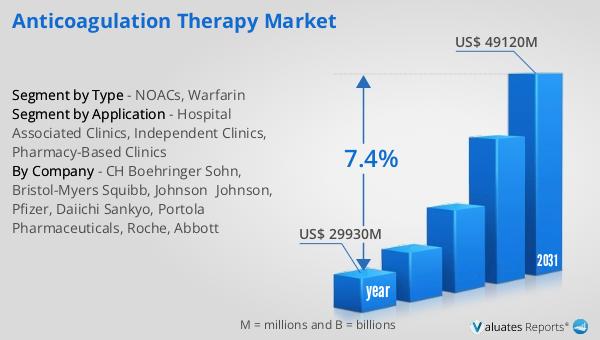
The global market for Anticoagulation Therapy was valued at approximately $29,930 million in 2024, with projections indicating it could reach around $49,120 million by 2031. This growth represents a compound annual growth rate (CAGR) of 7.4% over the forecast period. In comparison, the global pharmaceutical market was valued at $1,475 billion in 2022, with an expected CAGR of 5% over the next six years. Meanwhile, the chemical drug market was estimated to grow from $1,005 billion in 2018 to $1,094 billion by 2022. These figures highlight the robust growth potential of the anticoagulation therapy market, which is outpacing the broader pharmaceutical and chemical drug markets. The increasing prevalence of cardiovascular diseases, coupled with advancements in anticoagulation therapies, is driving this growth. As healthcare systems worldwide continue to prioritize preventive care and chronic disease management, the demand for effective anticoagulation treatments is expected to rise. This market outlook underscores the importance of ongoing research and development efforts aimed at enhancing the safety and efficacy of anticoagulation therapies, ensuring better patient outcomes and quality of life.
| Report Metric | Details |
| Report Name | Anticoagulation Therapy Market |
| Accounted market size in year | US$ 29930 million |
| Forecasted market size in 2031 | US$ 49120 million |
| CAGR | 7.4% |
| Base Year | year |
| Forecasted years | 2025 - 2031 |
| Segment by Type |
|
| Segment by Application |
|
| By Region |
|
| By Company | CH Boehringer Sohn, Bristol-Myers Squibb, Johnson&Johnson, Pfizer, Daiichi Sankyo, Portola Pharmaceuticals, Roche, Abbott |
| Forecast units | USD million in value |
| Report coverage | Revenue and volume forecast, company share, competitive landscape, growth factors and trends |




