What is Medical Grade Adhesive - Global Market?
Medical grade adhesives are specialized bonding agents used in the healthcare industry to ensure the safe and effective assembly of medical devices and components. These adhesives are formulated to meet stringent biocompatibility standards, ensuring they do not cause adverse reactions when in contact with human tissue or bodily fluids. They are used in a variety of applications, including the assembly of medical devices, wound care products, and surgical instruments. The global market for medical grade adhesives is driven by the increasing demand for advanced medical devices and the growing emphasis on minimally invasive surgical procedures. As healthcare technology advances, the need for reliable and durable adhesives that can withstand sterilization processes and maintain their integrity in challenging environments is paramount. The market is characterized by a diverse range of adhesive types, including acrylics, cyanoacrylates, epoxies, and silicones, each offering unique properties tailored to specific medical applications. The ongoing research and development in this field aim to enhance the performance and safety of these adhesives, further expanding their applications in the medical industry. As a result, the medical grade adhesive market is poised for significant growth, driven by technological advancements and the increasing adoption of innovative medical solutions.
Natural, Synthetic in the Medical Grade Adhesive - Global Market:
Medical grade adhesives can be broadly categorized into natural and synthetic types, each offering distinct advantages and applications in the healthcare industry. Natural adhesives are derived from biological sources and are often favored for their biocompatibility and biodegradability. These adhesives are typically used in applications where temporary bonding is required, such as wound closure and tissue repair. One of the most common natural adhesives is fibrin glue, which is derived from human or animal blood plasma. Fibrin glue is widely used in surgical procedures to promote hemostasis and tissue adhesion. Another example of a natural adhesive is gelatin-based adhesives, which are used in drug delivery systems and wound care products. These adhesives are known for their ability to form strong bonds with biological tissues and their capacity to degrade naturally over time, reducing the risk of adverse reactions. On the other hand, synthetic adhesives are engineered from chemical compounds and are designed to offer superior strength, durability, and resistance to environmental factors. These adhesives are often used in applications where long-lasting bonds are required, such as the assembly of medical devices and implants. Synthetic adhesives include a wide range of materials, such as acrylics, cyanoacrylates, epoxies, and silicones. Acrylic adhesives are known for their excellent adhesion to a variety of substrates and their resistance to moisture and chemicals, making them ideal for use in medical device assembly. Cyanoacrylates, commonly known as "super glues," are valued for their rapid bonding capabilities and are often used in emergency wound closure and surgical procedures. Epoxy adhesives offer exceptional mechanical strength and are used in applications where high load-bearing capacity is required, such as in orthopedic implants. Silicone adhesives are prized for their flexibility and biocompatibility, making them suitable for use in applications where movement and flexibility are essential, such as in wearable medical devices. The choice between natural and synthetic adhesives depends on the specific requirements of the application, including factors such as biocompatibility, bond strength, and environmental resistance. In many cases, a combination of both natural and synthetic adhesives may be used to achieve the desired performance characteristics. For example, a natural adhesive may be used to provide initial bonding and hemostasis, while a synthetic adhesive is applied to ensure long-term stability and durability. The development of hybrid adhesives that combine the benefits of both natural and synthetic materials is an area of active research, with the potential to offer enhanced performance and versatility in medical applications. The global market for medical grade adhesives is influenced by several factors, including the increasing demand for advanced medical devices, the growing prevalence of chronic diseases, and the rising emphasis on minimally invasive surgical procedures. As the healthcare industry continues to evolve, the need for reliable and effective adhesives that can meet the stringent requirements of medical applications is expected to drive market growth. The ongoing research and development efforts in this field aim to enhance the performance and safety of medical grade adhesives, further expanding their applications and contributing to the advancement of healthcare technology.
Medical Devices, Clinical Surgery, Others in the Medical Grade Adhesive - Global Market:
Medical grade adhesives play a crucial role in various medical applications, including medical devices, clinical surgery, and other healthcare-related areas. In the realm of medical devices, these adhesives are used to assemble and secure components, ensuring the functionality and reliability of the devices. They are employed in the production of a wide range of devices, such as catheters, syringes, and diagnostic equipment. The adhesives used in these applications must meet stringent biocompatibility standards and be able to withstand sterilization processes without compromising their integrity. The use of medical grade adhesives in medical devices is driven by the increasing demand for advanced healthcare solutions and the growing emphasis on patient safety and comfort. In clinical surgery, medical grade adhesives are used to close wounds, secure surgical instruments, and promote tissue adhesion. These adhesives offer several advantages over traditional sutures and staples, including reduced scarring, faster healing times, and decreased risk of infection. They are commonly used in minimally invasive surgical procedures, where precision and efficiency are paramount. The use of adhesives in surgery allows for more precise control over the bonding process, reducing the risk of complications and improving patient outcomes. The development of advanced adhesive formulations that offer enhanced performance and safety is a key focus of research in this field, with the potential to revolutionize surgical practices and improve patient care. Beyond medical devices and clinical surgery, medical grade adhesives are used in a variety of other healthcare applications. They are employed in wound care products, such as bandages and dressings, where they provide secure adhesion to the skin and promote healing. These adhesives are designed to be gentle on the skin, minimizing irritation and discomfort for patients. In drug delivery systems, medical grade adhesives are used to secure transdermal patches and other delivery devices, ensuring the accurate and consistent administration of medications. The use of adhesives in these applications is driven by the need for reliable and effective solutions that enhance patient compliance and improve therapeutic outcomes. The global market for medical grade adhesives is characterized by a diverse range of applications and a growing demand for innovative solutions. As healthcare technology continues to advance, the need for reliable and effective adhesives that can meet the stringent requirements of medical applications is expected to drive market growth. The ongoing research and development efforts in this field aim to enhance the performance and safety of medical grade adhesives, further expanding their applications and contributing to the advancement of healthcare technology. The versatility and effectiveness of medical grade adhesives make them an essential component of modern healthcare, with the potential to improve patient outcomes and revolutionize medical practices.
Medical Grade Adhesive - Global Market Outlook:
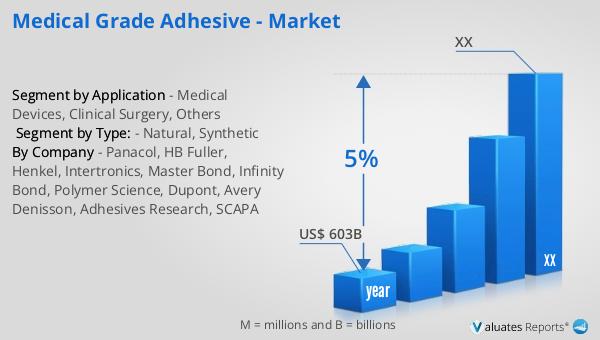
Based on our research, the global market for medical devices is projected to reach approximately $603 billion in 2023. This substantial market size reflects the growing demand for advanced medical technologies and innovative healthcare solutions worldwide. Over the next six years, the market is expected to experience a steady growth rate, with a compound annual growth rate (CAGR) of 5%. This growth is driven by several factors, including the increasing prevalence of chronic diseases, the aging global population, and the rising emphasis on personalized medicine and minimally invasive procedures. As healthcare systems around the world continue to evolve, the demand for cutting-edge medical devices that offer improved patient outcomes and enhanced efficiency is expected to rise. The market's expansion is also supported by ongoing advancements in medical technology, including the development of smart devices, wearable health monitors, and telemedicine solutions. These innovations are transforming the healthcare landscape, enabling more precise diagnostics, targeted treatments, and improved patient care. As a result, the global medical device market is poised for significant growth, offering numerous opportunities for industry players to capitalize on emerging trends and meet the evolving needs of healthcare providers and patients alike.
| Report Metric | Details |
| Report Name | Medical Grade Adhesive - Market |
| Accounted market size in year | US$ 603 billion |
| CAGR | 5% |
| Base Year | year |
| Segment by Type: |
|
| Segment by Application |
|
| By Region |
|
| By Company | Panacol, HB Fuller, Henkel, Intertronics, Master Bond, Infinity Bond, Polymer Science, Dupont, Avery Denisson, Adhesives Research, SCAPA |
| Forecast units | USD million in value |
| Report coverage | Revenue and volume forecast, company share, competitive landscape, growth factors and trends |




