What is Global Ultraviolet Stabilizers Market?
The Global Ultraviolet Stabilizers Market is a crucial segment within the broader chemical industry, focusing on products that protect materials from the harmful effects of ultraviolet (UV) radiation. UV stabilizers are essential additives used in various industries to enhance the durability and longevity of products exposed to sunlight. These stabilizers work by absorbing or reflecting UV radiation, thereby preventing degradation, discoloration, and loss of mechanical properties in materials such as plastics, coatings, and fibers. The market is driven by the increasing demand for UV-resistant materials in sectors like automotive, construction, and packaging. As industries continue to prioritize sustainability and product longevity, the need for effective UV stabilization solutions is expected to grow. This market is characterized by continuous innovation, with companies investing in research and development to create more efficient and environmentally friendly stabilizers. The global reach of this market is evident as it caters to diverse industries across different regions, each with unique requirements and challenges. Overall, the Global Ultraviolet Stabilizers Market plays a vital role in enhancing the performance and lifespan of materials, contributing to economic and environmental sustainability.
Hindered Amine Light Stabilizer (HALS), UV Absorbers, Quenchers in the Global Ultraviolet Stabilizers Market:
Hindered Amine Light Stabilizers (HALS), UV Absorbers, and Quenchers are three primary types of ultraviolet stabilizers used in the Global Ultraviolet Stabilizers Market. HALS are highly effective in preventing the degradation of polymers by scavenging free radicals formed during photo-oxidation. They do not absorb UV radiation but instead work by interrupting the degradation process, making them particularly useful in applications where long-term stability is required. HALS are widely used in automotive coatings, agricultural films, and outdoor furniture due to their ability to provide long-lasting protection against UV radiation. UV Absorbers, on the other hand, function by absorbing harmful UV radiation and dissipating it as heat, thereby protecting the material from damage. These stabilizers are commonly used in applications where transparency and color stability are crucial, such as in packaging films and clear coatings. UV Absorbers are often combined with other stabilizers to enhance their effectiveness and provide comprehensive protection. Quenchers are another type of UV stabilizer that work by deactivating excited states of molecules, preventing them from reacting with oxygen and causing degradation. They are often used in combination with HALS and UV Absorbers to provide a synergistic effect, enhancing the overall stability of materials exposed to UV radiation. The choice of stabilizer depends on the specific requirements of the application, including the type of material, exposure conditions, and desired lifespan. In the Global Ultraviolet Stabilizers Market, manufacturers are continually developing new formulations and technologies to improve the performance and efficiency of these stabilizers. This includes the development of non-toxic and environmentally friendly options to meet regulatory requirements and consumer preferences. As industries continue to demand high-performance materials that can withstand harsh environmental conditions, the role of HALS, UV Absorbers, and Quenchers in the Global Ultraviolet Stabilizers Market is expected to grow. These stabilizers not only enhance the durability and appearance of products but also contribute to sustainability by reducing the need for frequent replacements and minimizing waste. Overall, the Global Ultraviolet Stabilizers Market is a dynamic and evolving sector, driven by innovation and the increasing demand for UV-resistant materials across various industries.
Flooring and Decking, Furniture, Automotive Coating, Packaging in the Global Ultraviolet Stabilizers Market:
The Global Ultraviolet Stabilizers Market finds extensive usage in several key areas, including flooring and decking, furniture, automotive coating, and packaging. In the flooring and decking industry, UV stabilizers are essential for maintaining the appearance and structural integrity of materials exposed to sunlight. Outdoor flooring and decking materials, such as wood composites and plastics, are particularly susceptible to UV-induced degradation, which can lead to discoloration, cracking, and loss of mechanical properties. By incorporating UV stabilizers, manufacturers can enhance the durability and lifespan of these materials, ensuring they remain aesthetically pleasing and functional over time. In the furniture industry, UV stabilizers are used to protect both indoor and outdoor furniture from the damaging effects of UV radiation. Outdoor furniture, in particular, is exposed to harsh environmental conditions, making it prone to fading, brittleness, and surface degradation. UV stabilizers help preserve the color, texture, and strength of furniture materials, extending their lifespan and reducing maintenance costs. In the automotive industry, UV stabilizers play a crucial role in automotive coatings, protecting vehicles from the harmful effects of sunlight. Automotive coatings are designed to provide a protective barrier against UV radiation, preventing paint fading, surface cracking, and corrosion. By using UV stabilizers, manufacturers can ensure that vehicles maintain their appearance and value over time, even when exposed to intense sunlight. In the packaging industry, UV stabilizers are used to protect packaging materials from UV-induced degradation, which can compromise the integrity and appearance of the packaging. This is particularly important for products that are stored or displayed outdoors, such as agricultural products, construction materials, and consumer goods. By incorporating UV stabilizers, manufacturers can enhance the durability and performance of packaging materials, ensuring they remain effective in protecting the contents and maintaining their visual appeal. Overall, the Global Ultraviolet Stabilizers Market plays a vital role in enhancing the performance and longevity of materials used in flooring and decking, furniture, automotive coating, and packaging. By providing effective protection against UV radiation, these stabilizers contribute to the sustainability and economic viability of products across various industries.
Global Ultraviolet Stabilizers Market Outlook:
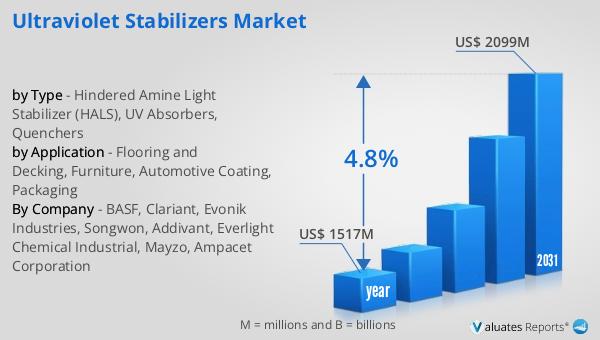
The worldwide market for Ultraviolet Stabilizers was estimated to be worth $1,517 million in 2024, with expectations to expand to a revised valuation of $2,099 million by 2031, reflecting a compound annual growth rate (CAGR) of 4.8% throughout the forecast period. This growth trajectory underscores the increasing demand for UV stabilizers across various industries, driven by the need to enhance the durability and longevity of materials exposed to sunlight. As industries such as automotive, construction, and packaging continue to prioritize sustainability and product longevity, the demand for effective UV stabilization solutions is expected to rise. The market's expansion is also fueled by continuous innovation, with companies investing in research and development to create more efficient and environmentally friendly stabilizers. The global reach of this market is evident as it caters to diverse industries across different regions, each with unique requirements and challenges. As the market evolves, manufacturers are focusing on developing new formulations and technologies to improve the performance and efficiency of UV stabilizers. This includes the development of non-toxic and environmentally friendly options to meet regulatory requirements and consumer preferences. Overall, the Global Ultraviolet Stabilizers Market is a dynamic and evolving sector, driven by innovation and the increasing demand for UV-resistant materials across various industries.
| Report Metric | Details |
| Report Name | Ultraviolet Stabilizers Market |
| Accounted market size in year | US$ 1517 million |
| Forecasted market size in 2031 | US$ 2099 million |
| CAGR | 4.8% |
| Base Year | year |
| Forecasted years | 2025 - 2031 |
| by Type |
|
| by Application |
|
| Production by Region |
|
| Consumption by Region |
|
| By Company | BASF, Clariant, Evonik Industries, Songwon, Addivant, Everlight Chemical Industrial, Mayzo, Ampacet Corporation |
| Forecast units | USD million in value |
| Report coverage | Revenue and volume forecast, company share, competitive landscape, growth factors and trends |




