What is Global Small Cell Networks Market?
The Global Small Cell Networks Market is an evolving sector that's reshaping how we think about telecommunications infrastructure. At its core, this market focuses on the deployment of small cell networks, which are essentially miniature cellular base stations. These small cells are crucial for extending the reach and capacity of mobile networks, especially in densely populated urban areas or regions where traditional, larger cell towers struggle to provide adequate coverage. Small cells help in addressing the increasing demand for data by offloading traffic from the main network, thereby improving service quality and user experience. They are instrumental in supporting the burgeoning growth of mobile data traffic, driven by the proliferation of smartphones, tablets, and the rapid expansion of Internet of Things (IoT) devices. As the world becomes more connected, the importance of small cell networks in ensuring seamless connectivity and communication cannot be overstated. Their role is becoming increasingly significant as we move towards more advanced wireless technologies like 5G, which requires a denser network infrastructure to deliver its full potential in terms of speed, capacity, and latency. The Global Small Cell Networks Market is thus a critical area of focus for telecom operators, equipment manufacturers, and service providers aiming to meet the current and future demands of a digitally connected society.
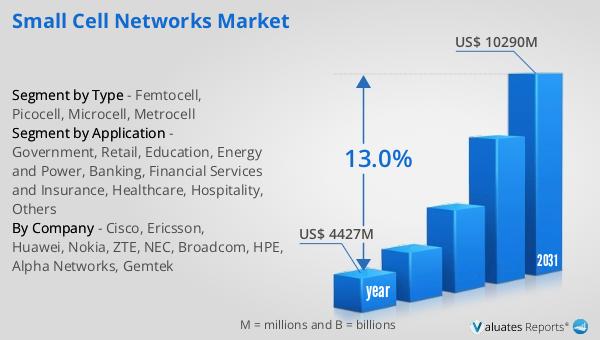
Femtocell, Picocell, Microcell, Metrocell in the Global Small Cell Networks Market:
Diving into the Global Small Cell Networks Market, we encounter various types of small cells, each serving different needs and environments. Femtocells, Picocells, Microcells, and Metrocells are the primary categories, each with its unique characteristics and applications. Femtocells are the smallest and typically used in residential or small business settings. They connect to the service provider’s network via broadband (like DSL or cable) and extend cellular coverage indoors where signals might be weak. Picocells, a bit larger than femtocells, cater to small areas like offices, shops, or small buildings, providing enhanced coverage and capacity in areas with dense but contained user populations. Microcells cover larger areas like stadiums, malls, or dense urban districts, offering a solution to high traffic volumes over broader areas. Lastly, Metrocells, which are the largest of the small cells, are deployed in densely populated urban areas to provide additional capacity and coverage where it's most needed, often in outdoor settings. Together, these small cell types form a versatile and adaptive network infrastructure capable of supporting the diverse and growing demands of the Global Small Cell Networks Market. They are pivotal in enabling telecom operators to efficiently manage network traffic, improve service quality, and facilitate the rollout of next-generation wireless technologies.
Government, Retail, Education, Energy and Power, Banking, Financial Services and Insurance, Healthcare, Hospitality, Others in the Global Small Cell Networks Market:
The Global Small Cell Networks Market finds its applications across a wide range of sectors, demonstrating its versatility and critical role in modern infrastructure. In government operations, small cell networks enhance communication capabilities and support public safety networks, ensuring reliable connectivity for emergency services. Retail businesses leverage these networks to provide customers with enhanced in-store experiences, such as mobile payments and targeted promotions, through improved cellular connectivity. In the education sector, small cells facilitate the digital transformation of campuses, supporting online learning platforms and the increasing number of connected devices used by students and faculty. Energy and power industries utilize small cell networks to monitor and manage infrastructure remotely, improving efficiency and safety. The banking, financial services, and insurance (BFSI) sector relies on robust connectivity for secure transactions and real-time data processing, areas where small cells can significantly contribute. Healthcare institutions use these networks to support telemedicine services and the growing ecosystem of IoT devices for patient monitoring. In hospitality, small cells enhance guest experiences by ensuring strong mobile coverage throughout properties. The "Others" category, which includes transportation, manufacturing, and more, also benefits from the deployment of small cell networks, highlighting their broad applicability and importance in supporting various facets of the digital economy. The Global Small Cell Networks Market thus plays a foundational role in enabling connectivity and supporting the digital transformation across multiple industries.
Global Small Cell Networks Market Outlook:
The market outlook for the Global Small Cell Networks Market presents a promising future. As of 2023, the market's value stood at approximately $3394.4 million. Looking ahead, projections suggest a significant growth trajectory, with expectations to reach around $8250.7 million by the year 2030. This anticipated growth, marked by a compound annual growth rate (CAGR) of 13.0% during the forecast period from 2024 to 2030, underscores the increasing reliance on small cell networks across various sectors. This growth is driven by the escalating demand for enhanced telecommunications infrastructure capable of supporting the exponential increase in mobile data traffic and the deployment of next-generation wireless technologies. The expansion of the Global Small Cell Networks Market is indicative of the critical role these networks play in not only improving cellular coverage and capacity but also in facilitating the digital transformation of industries worldwide. As we move further into the digital age, the importance of robust and efficient telecommunications infrastructure, exemplified by small cell networks, cannot be overstated, making this market a key area of focus for stakeholders across the globe.
| Report Metric | Details |
| Report Name | Small Cell Networks Market |
| Accounted market size in 2023 | US$ 3394.4 million |
| Forecasted market size in 2030 | US$ 8250.7 million |
| CAGR | 13.0% |
| Base Year | 2023 |
| Forecasted years | 2024 - 2030 |
| Segment by Type |
|
| Segment by Application |
|
| By Region |
|
| By Company | Cisco, Ericsson, Huawei, Nokia, ZTE, NEC, Broadcom, HPE, Alpha Networks, Gemtek |
| Forecast units | USD million in value |
| Report coverage | Revenue and volume forecast, company share, competitive landscape, growth factors and trends |




