What is Global Construction Robotics Market?
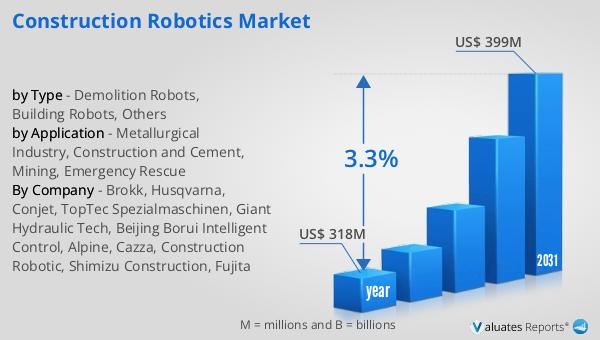
The Global Construction Robotics Market is a rapidly evolving sector that represents the integration of robotics technology into the construction industry to enhance efficiency, safety, and productivity. This market encompasses a wide range of robotic solutions designed for various construction activities, from building and demolition to material handling and surveying. As of 2023, the market's value stood at approximately US$ 297 million, showcasing the growing interest and investment in robotic technologies within the construction sector. The anticipated growth, with a compound annual growth rate (CAGR) of 3.3%, is expected to propel the market value to US$ 375.6 million by 2030. This growth trajectory is supported by the increasing adoption of automation and robotics in construction processes to tackle challenges such as labor shortages, the need for improved safety standards, and the demand for faster construction times. The market is characterized by a concentration of key players, with the top five manufacturers accounting for about 85% of the market share, indicating a competitive yet consolidated market landscape. Among the various products, demolition robots emerge as the dominant segment, holding approximately 90% of the product-based market share, underscoring their significant role in modern construction methodologies. This segment's prominence highlights the industry's focus on leveraging robotic technology to enhance demolition efficiency and safety, reflecting broader trends towards automation and innovation in construction practices.
Demolition Robots, Building Robots, Others in the Global Construction Robotics Market:
In the realm of the Global Construction Robotics Market, three primary categories stand out: Demolition Robots, Building Robots, and Others, each playing a pivotal role in transforming construction methodologies through advanced automation and technology. Demolition robots, leading the charge, are engineered for precision, safety, and efficiency in tearing down structures. These robots are equipped with various attachments like crushers, breakers, and shears, enabling them to tackle different materials and demolition scenarios. Their remote-controlled operation minimizes human exposure to hazardous conditions, making demolition activities safer and more controlled. Building robots, on the other hand, are revolutionizing the way structures are erected. From laying bricks to pouring concrete and installing drywall, these robots offer unparalleled precision and speed, significantly reducing construction times and labor costs. Their ability to work in challenging environments without fatigue or the need for breaks further enhances productivity and project timelines. The 'Others' category encompasses a broad spectrum of robotic solutions tailored for specific construction tasks, including but not limited to, surveying, material handling, and welding. These robots are designed to perform repetitive, labor-intensive tasks with high efficiency and accuracy, contributing to the overall improvement of construction quality and worker safety. The integration of these robotic solutions across different construction phases signifies a shift towards more automated, efficient, and safer construction practices, underscoring the dynamic and innovative nature of the Global Construction Robotics Market.
Metallurgical Industry, Construction and Cement, Mining, Emergency Rescue in the Global Construction Robotics Market:
The Global Construction Robotics Market finds its application across various industries, significantly impacting sectors like the Metallurgical Industry, Construction and Cement, Mining, and Emergency Rescue. In the Metallurgical Industry, robotics technology is employed to enhance precision and safety in tasks such as welding, material handling, and assembly operations. The high degree of precision offered by robots, coupled with their ability to work in hazardous environments, improves operational efficiency and worker safety. In the Construction and Cement sector, robots are revolutionizing traditional practices by automating tasks like bricklaying, concrete pouring, and structural inspections. This not only speeds up the construction process but also reduces the likelihood of human error, ensuring higher quality outcomes. Mining operations benefit from robotics in exploration, drilling, and ore processing, where robots can perform tasks in environments that are unsafe for human workers, thereby increasing productivity and ensuring safety. Lastly, in Emergency Rescue operations, robots play a crucial role in search and rescue missions, especially in environments that are inaccessible or dangerous for humans. They are equipped with sensors and cameras to navigate through debris and hazardous areas, providing real-time data and assistance in rescue operations. The usage of construction robotics in these areas underscores the versatility and potential of robotic technologies to transform traditional industries by enhancing efficiency, safety, and quality of operations.
Global Construction Robotics Market Outlook:
The outlook for the Global Construction Robotics Market presents a promising future, with the market's valuation at US$ 297 million in 2023, and an expected rise to US$ 375.6 million by 2030. This growth, projected at a CAGR of 3.3% during the forecast period from 2024 to 2030, reflects the increasing adoption and integration of robotics in the construction industry. The market is characterized by a significant concentration of key players, with the top five manufacturers collectively holding about 85% of the market share. This indicates a competitive yet consolidated market environment, where innovation and technological advancements are pivotal. Among the various segments within this market, demolition robots stand out, accounting for about 90% of the product-based market share. This dominance underscores the critical role that demolition robots play in modern construction processes, highlighting the industry's shift towards more efficient, safe, and technologically driven practices. The emphasis on demolition robots also points to the broader trend of automating high-risk, labor-intensive tasks, aligning with the industry's goals of enhancing safety and productivity through technological innovation.
| Report Metric | Details |
| Report Name | Construction Robotics Market |
| Accounted market size in 2023 | US$ 297 million |
| Forecasted market size in 2030 | US$ 375.6 million |
| CAGR | 3.3% |
| Base Year | 2023 |
| Forecasted years | 2024 - 2030 |
| Segment by Type |
|
| Segment by Application |
|
| Production by Region |
|
| Consumption by Region |
|
| By Company | Brokk, Husqvarna, Conjet, TopTec Spezialmaschinen, Giant Hydraulic Tech, Beijing Borui Intelligent Control, Alpine, Cazza, Construction Robotic, Shimizu Construction, Fujita |
| Forecast units | USD million in value |
| Report coverage | Revenue and volume forecast, company share, competitive landscape, growth factors and trends |




