What is Global Polio Vaccines Market?
The Global Polio Vaccines Market is a crucial segment of the pharmaceutical industry, dedicated to eradicating polio worldwide. Polio, a highly infectious viral disease, primarily affects children under the age of five, leading to irreversible paralysis and, in some cases, death. The market for polio vaccines is driven by the global initiative to eliminate polio, spearheaded by organizations such as the World Health Organization (WHO), UNICEF, and the Global Polio Eradication Initiative (GPEI). These organizations work tirelessly to ensure that polio vaccines reach even the most remote areas of the world. The market comprises two main types of vaccines: Inactivated Polio Vaccine (IPV) and Oral Polio Vaccine (OPV). IPV is administered via injection and contains an inactivated virus, while OPV is given orally and contains a weakened form of the virus. Both vaccines are essential in the fight against polio, with IPV being more commonly used in developed countries and OPV in developing regions due to its ease of administration and cost-effectiveness. The global polio vaccines market is characterized by continuous research and development efforts to improve vaccine efficacy and safety, ensuring that the goal of a polio-free world is achieved.
IPV, OPV in the Global Polio Vaccines Market:
In the Global Polio Vaccines Market, two primary vaccines are utilized: Inactivated Polio Vaccine (IPV) and Oral Polio Vaccine (OPV). IPV, developed by Dr. Jonas Salk in the 1950s, is administered through injection and contains an inactivated or killed version of the poliovirus. This vaccine is known for its safety and effectiveness in preventing polio, as it induces a strong immune response without the risk of vaccine-derived poliovirus. IPV is predominantly used in developed countries where the infrastructure supports its administration and where the risk of polio transmission is low. On the other hand, OPV, developed by Dr. Albert Sabin, is administered orally and contains a live, attenuated (weakened) form of the virus. OPV is favored in many developing countries due to its ease of administration, low cost, and ability to induce both humoral and intestinal immunity. This dual immunity is crucial in areas with high transmission rates, as it helps prevent the spread of the virus in the community. However, OPV carries a small risk of vaccine-derived poliovirus, which has led to a gradual shift towards IPV in some regions. The Global Polio Vaccines Market is influenced by various factors, including government policies, funding from international organizations, and public awareness campaigns. Governments play a critical role in the procurement and distribution of polio vaccines, often working in collaboration with international bodies to ensure that vaccines reach all children, regardless of their location. Funding from organizations such as the Bill & Melinda Gates Foundation has been instrumental in supporting vaccination campaigns and research initiatives aimed at improving vaccine formulations and delivery methods. Public awareness campaigns are also vital in encouraging vaccination uptake, dispelling myths, and educating communities about the importance of immunization. The market is also characterized by ongoing research and development efforts to enhance vaccine efficacy and safety. Scientists are continually exploring new technologies and formulations to improve the stability and immunogenicity of polio vaccines. For instance, efforts are being made to develop heat-stable vaccines that can withstand the challenging conditions of remote areas without compromising their effectiveness. Additionally, research is focused on creating combination vaccines that can protect against multiple diseases, thereby simplifying immunization schedules and increasing coverage rates. The Global Polio Vaccines Market is not without its challenges. Vaccine hesitancy, driven by misinformation and cultural beliefs, poses a significant barrier to achieving high vaccination coverage. In some regions, political instability and conflict further complicate vaccination efforts, making it difficult to reach vulnerable populations. Despite these challenges, the market remains resilient, driven by the collective commitment of governments, organizations, and communities to eradicate polio once and for all. The transition from OPV to IPV in many countries is a testament to the market's adaptability and dedication to ensuring the highest standards of safety and efficacy. As the world moves closer to achieving polio eradication, the Global Polio Vaccines Market will continue to play a pivotal role in safeguarding the health of future generations.
Age (0-1), Age Above 1 in the Global Polio Vaccines Market:
The usage of polio vaccines in the Global Polio Vaccines Market is stratified by age, with specific focus on children aged 0-1 and those above 1 year. For infants aged 0-1, vaccination is crucial as this age group is most vulnerable to the poliovirus. The immunization schedule typically begins at birth or within the first few months of life, depending on the country's health guidelines. In many countries, the first dose of the Oral Polio Vaccine (OPV) is administered at birth, followed by subsequent doses at regular intervals. This early administration is vital in providing immediate protection against the virus, especially in regions with high transmission rates. The Inactivated Polio Vaccine (IPV) is also introduced during infancy, often as part of a combination vaccine that protects against multiple diseases. The use of combination vaccines simplifies the immunization process, reducing the number of injections required and increasing compliance among caregivers. For children above the age of 1, booster doses are essential to maintain immunity and ensure long-term protection against polio. The Global Polio Vaccines Market recognizes the importance of booster doses in sustaining immunity, particularly in areas where the risk of poliovirus transmission remains high. Booster doses are typically administered during routine immunization visits, often in conjunction with other vaccines. This approach not only reinforces immunity but also maximizes the efficiency of vaccination programs by integrating polio vaccines into broader public health initiatives. In addition to routine immunization, supplementary immunization activities (SIAs) are conducted to reach children who may have missed their scheduled doses. These campaigns are particularly important in regions with low vaccination coverage or during outbreaks, as they help close immunity gaps and prevent the spread of the virus. The Global Polio Vaccines Market is committed to ensuring that all children, regardless of age, have access to life-saving vaccines. This commitment is reflected in the efforts to improve vaccine accessibility and affordability, particularly in low-income countries. Partnerships between governments, international organizations, and vaccine manufacturers are crucial in achieving this goal, as they facilitate the procurement and distribution of vaccines to underserved areas. The market also emphasizes the importance of monitoring and evaluation to track vaccination coverage and identify areas for improvement. Data-driven approaches are employed to assess the effectiveness of vaccination programs and inform policy decisions. This includes the use of surveillance systems to detect and respond to cases of poliovirus promptly. By leveraging data and technology, the Global Polio Vaccines Market aims to optimize vaccination strategies and ensure that no child is left unprotected. In conclusion, the usage of polio vaccines in the Global Polio Vaccines Market is tailored to meet the needs of different age groups, with a strong emphasis on early immunization and booster doses. Through a combination of routine immunization, supplementary campaigns, and strategic partnerships, the market strives to achieve comprehensive coverage and ultimately eradicate polio worldwide.
Global Polio Vaccines Market Outlook:
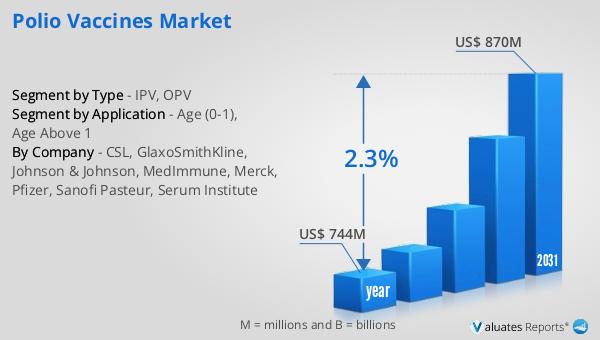
The global market for polio vaccines was valued at $744 million in 2024 and is expected to grow to $870 million by 2031, with a compound annual growth rate (CAGR) of 2.3% during this period. This growth reflects the ongoing efforts to eradicate polio and the increasing demand for vaccines in both developed and developing countries. In comparison, the global pharmaceutical market was valued at $1,475 billion in 2022, with a projected CAGR of 5% over the next six years. This indicates a robust growth trajectory for the pharmaceutical industry as a whole, driven by advancements in drug development, increasing healthcare expenditure, and the rising prevalence of chronic diseases. Meanwhile, the chemical drug market, a subset of the pharmaceutical industry, was estimated to grow from $1,005 billion in 2018 to $1,094 billion in 2022. This growth underscores the continued reliance on chemical drugs for the treatment of various medical conditions, despite the increasing interest in biologics and personalized medicine. The polio vaccines market, while smaller in comparison to the broader pharmaceutical and chemical drug markets, plays a critical role in global public health. Its growth is fueled by international initiatives to eliminate polio, government support for vaccination programs, and the development of new vaccine technologies. As the world moves closer to achieving polio eradication, the market for polio vaccines will continue to be an essential component of the global healthcare landscape.
| Report Metric | Details |
| Report Name | Polio Vaccines Market |
| Accounted market size in year | US$ 744 million |
| Forecasted market size in 2031 | US$ 870 million |
| CAGR | 2.3% |
| Base Year | year |
| Forecasted years | 2025 - 2031 |
| Segment by Type |
|
| Segment by Application |
|
| Consumption by Region |
|
| By Company | CSL, GlaxoSmithKline, Johnson & Johnson, MedImmune, Merck, Pfizer, Sanofi Pasteur, Serum Institute |
| Forecast units | USD million in value |
| Report coverage | Revenue and volume forecast, company share, competitive landscape, growth factors and trends |




