What is Global Antihelminthics Market?
The Global Antihelminthics Market is a crucial segment of the pharmaceutical industry, focusing on the development and distribution of medications designed to treat infections caused by helminths, which are parasitic worms. These infections are prevalent in both humans and animals, particularly in regions with poor sanitation and hygiene. Antihelminthic drugs work by either killing the parasites or expelling them from the host's body. The market is driven by the high prevalence of helminth infections worldwide, increasing awareness about the importance of treating these infections, and advancements in drug development. Additionally, the rise in veterinary care and the need for effective treatments in livestock and pets further fuel the demand for antihelminthic products. The market is characterized by a diverse range of products, including both broad-spectrum and narrow-spectrum drugs, catering to various types of helminth infections. As global health organizations continue to emphasize the importance of controlling parasitic infections, the demand for effective antihelminthic treatments is expected to remain strong. The market also faces challenges such as drug resistance and the need for affordable treatments in low-income regions. Overall, the Global Antihelminthics Market plays a vital role in improving public health and animal welfare by providing essential treatments for parasitic infections.
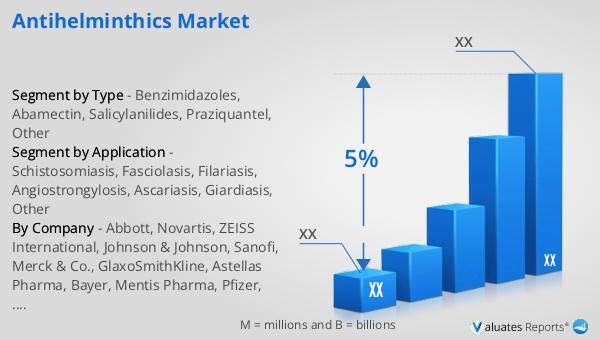
Benzimidazoles, Abamectin, Salicylanilides, Praziquantel, Other in the Global Antihelminthics Market:
Benzimidazoles, Abamectin, Salicylanilides, Praziquantel, and other compounds are key components of the Global Antihelminthics Market, each offering unique properties and applications in the treatment of parasitic infections. Benzimidazoles are a class of broad-spectrum antihelminthic drugs that are effective against a wide range of parasitic worms, including roundworms, tapeworms, and flukes. They work by inhibiting the polymerization of tubulin, a protein essential for the formation of microtubules, which are crucial for the survival and reproduction of parasites. This disruption leads to the death of the parasites. Benzimidazoles are commonly used in both human and veterinary medicine due to their efficacy and safety profile. Abamectin, on the other hand, is a macrocyclic lactone derived from the fermentation of Streptomyces avermitilis. It is primarily used in veterinary medicine to treat parasitic infections in livestock and pets. Abamectin works by binding to glutamate-gated chloride channels in the nervous system of parasites, leading to paralysis and death. Its effectiveness against a wide range of parasites, including nematodes and arthropods, makes it a valuable tool in animal health. Salicylanilides are another class of antihelminthic compounds that are particularly effective against tapeworms and flukes. They work by uncoupling oxidative phosphorylation in the mitochondria of parasites, leading to energy depletion and death. Salicylanilides are often used in combination with other drugs to enhance their efficacy and broaden their spectrum of activity. Praziquantel is a widely used antihelminthic drug that is particularly effective against schistosomes and tapeworms. It works by increasing the permeability of the parasite's cell membrane to calcium ions, leading to muscle contraction and paralysis. This action results in the detachment of the parasites from the host's tissues and their eventual death. Praziquantel is considered the drug of choice for the treatment of schistosomiasis and is also used in the treatment of other parasitic infections. Other compounds in the Global Antihelminthics Market include a variety of drugs with specific mechanisms of action and target parasites. These drugs are often used in combination therapies to enhance their efficacy and reduce the risk of drug resistance. The development of new antihelminthic drugs continues to be an area of active research, driven by the need for more effective and safer treatments for parasitic infections. Overall, the diverse range of compounds in the Global Antihelminthics Market provides essential tools for the treatment and control of parasitic infections in both humans and animals.
Schistosomiasis, Fasciolasis, Filariasis, Angiostrongylosis, Ascariasis, Giardiasis, Other in the Global Antihelminthics Market:
The Global Antihelminthics Market plays a significant role in the treatment of various parasitic infections, including schistosomiasis, fascioliasis, filariasis, angiostrongylosis, ascariasis, giardiasis, and others. Schistosomiasis, caused by blood flukes of the genus Schistosoma, is a major public health concern in many tropical and subtropical regions. Praziquantel is the primary drug used to treat schistosomiasis, as it effectively kills the adult worms and reduces the severity of the disease. Fascioliasis, caused by liver flukes such as Fasciola hepatica, affects both humans and livestock. Triclabendazole, a benzimidazole derivative, is commonly used to treat fascioliasis due to its high efficacy against both immature and adult flukes. Filariasis, a mosquito-borne disease caused by filarial worms, can lead to severe symptoms such as lymphedema and elephantiasis. The treatment of filariasis often involves a combination of drugs, including diethylcarbamazine, ivermectin, and albendazole, to target different stages of the parasite's life cycle. Angiostrongylosis, caused by the rat lungworm Angiostrongylus cantonensis, is an emerging parasitic infection that can lead to eosinophilic meningitis in humans. The treatment of angiostrongylosis is primarily supportive, but antihelminthic drugs such as albendazole may be used to reduce the parasite load. Ascariasis, caused by the roundworm Ascaris lumbricoides, is one of the most common helminth infections worldwide. Benzimidazoles such as albendazole and mebendazole are the drugs of choice for treating ascariasis, as they effectively kill the adult worms and reduce the risk of reinfection. Giardiasis, caused by the protozoan parasite Giardia lamblia, is a common cause of diarrhea in both children and adults. Although not a helminth infection, giardiasis is often treated with antihelminthic drugs such as metronidazole and tinidazole, which are effective against the parasite. Other parasitic infections, such as hookworm and whipworm infections, are also treated with antihelminthic drugs, often in combination with other medications to enhance their efficacy. The Global Antihelminthics Market provides a wide range of treatment options for these and other parasitic infections, contributing to improved public health and quality of life for affected individuals.
Global Antihelminthics Market Outlook:
In 2022, the global pharmaceutical market reached a valuation of 1,475 billion USD, demonstrating a steady growth trajectory with a compound annual growth rate (CAGR) of 5% projected over the next six years. This growth reflects the increasing demand for pharmaceutical products driven by factors such as an aging population, rising prevalence of chronic diseases, and advancements in drug development. In comparison, the chemical drug market, a significant segment of the pharmaceutical industry, has also shown substantial growth. From 2018 to 2022, the chemical drug market expanded from 1,005 billion USD to 1,094 billion USD. This growth can be attributed to the continuous innovation in chemical drug formulations, the introduction of new therapies, and the expansion of healthcare infrastructure in emerging markets. The chemical drug market's growth is also supported by the increasing focus on personalized medicine and targeted therapies, which require specialized chemical compounds. As the pharmaceutical industry continues to evolve, both the overall market and the chemical drug segment are expected to maintain their upward trajectory, driven by ongoing research and development efforts and the growing demand for effective and innovative treatments. The robust growth of these markets underscores the critical role of pharmaceuticals in addressing global health challenges and improving patient outcomes.
| Report Metric | Details |
| Report Name | Antihelminthics Market |
| CAGR | 5% |
| Segment by Type |
|
| Segment by Application |
|
| Consumption by Region |
|
| By Company | Abbott, Novartis, ZEISS International, Johnson & Johnson, Sanofi, Merck & Co., GlaxoSmithKline, Astellas Pharma, Bayer, Mentis Pharma, Pfizer, ALLERGAN, AstraZeneca |
| Forecast units | USD million in value |
| Report coverage | Revenue and volume forecast, company share, competitive landscape, growth factors and trends |




