What is Global Influenza Medication Market?
The Global Influenza Medication Market refers to the worldwide industry focused on the development, production, and distribution of medications designed to treat influenza, commonly known as the flu. Influenza is a contagious respiratory illness caused by influenza viruses, which can lead to mild to severe illness and, at times, can result in hospitalization or even death. The market for influenza medications is driven by the need to manage and mitigate the impact of seasonal flu outbreaks and potential pandemics. This market encompasses a range of antiviral drugs that are used to treat and prevent influenza infections. The demand for these medications is influenced by factors such as the prevalence of influenza, the emergence of new strains of the virus, and public health initiatives aimed at controlling flu outbreaks. Additionally, the market is shaped by advancements in pharmaceutical research and development, which lead to the introduction of new and more effective treatments. As a result, the Global Influenza Medication Market plays a crucial role in public health by providing essential tools for the management and control of influenza infections worldwide.
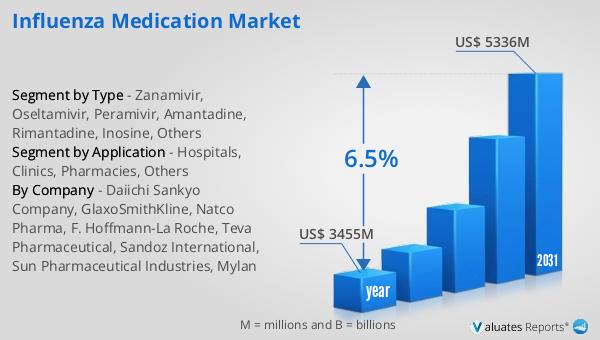
Zanamivir, Oseltamivir, Peramivir, Amantadine, Rimantadine, Inosine, Others in the Global Influenza Medication Market:
Zanamivir, Oseltamivir, Peramivir, Amantadine, Rimantadine, Inosine, and other medications are key components of the Global Influenza Medication Market, each with unique properties and applications. Zanamivir, marketed under the brand name Relenza, is an antiviral drug that belongs to the neuraminidase inhibitor class. It is administered via inhalation and works by blocking the function of the viral neuraminidase protein, thereby preventing the virus from spreading within the respiratory tract. Oseltamivir, commonly known as Tamiflu, is another neuraminidase inhibitor that is taken orally. It is widely used for both the treatment and prevention of influenza and is effective against both influenza A and B viruses. Peramivir, sold under the brand name Rapivab, is an intravenous neuraminidase inhibitor used primarily in hospital settings for patients who cannot take oral medications. Amantadine and Rimantadine are older antiviral drugs that target the M2 protein of the influenza A virus, inhibiting viral replication. However, their use has declined due to the development of resistance among influenza strains. Inosine, a nucleoside, is sometimes used as an adjunct therapy to boost the immune system, although its efficacy in treating influenza is not well-established. The category of "Others" includes various experimental and emerging treatments that are being researched and developed to address the limitations of existing medications and to combat resistant strains of the virus. These medications are crucial in the fight against influenza, as they provide healthcare professionals with a range of options to tailor treatment to individual patient needs and to respond to the evolving nature of influenza viruses. The development and availability of these drugs are essential for reducing the burden of influenza on public health systems and for improving patient outcomes during flu seasons and potential pandemics.
Hospitals, Clinics, Pharmacies, Others in the Global Influenza Medication Market:
The usage of Global Influenza Medication Market products spans various healthcare settings, including hospitals, clinics, pharmacies, and other facilities. In hospitals, influenza medications are critical for managing severe cases of the flu, particularly in patients who are at high risk of complications, such as the elderly, young children, and individuals with underlying health conditions. Hospitals often use intravenous medications like Peramivir for patients who are unable to take oral medications or who require rapid intervention. Clinics, on the other hand, serve as the first point of contact for many patients experiencing flu symptoms. In these settings, medications like Oseltamivir and Zanamivir are commonly prescribed to reduce the severity and duration of symptoms and to prevent the spread of the virus to others. Pharmacies play a vital role in the distribution of influenza medications, providing patients with access to prescribed treatments and offering over-the-counter options for symptom relief. Pharmacists also serve as an important source of information and guidance for patients seeking advice on managing flu symptoms and preventing transmission. Other settings, such as long-term care facilities and community health centers, also utilize influenza medications to protect vulnerable populations and to manage outbreaks within their communities. The availability and accessibility of these medications across different healthcare settings are crucial for ensuring timely and effective treatment of influenza, thereby reducing the overall impact of the virus on public health. By providing a range of treatment options, the Global Influenza Medication Market supports healthcare providers in delivering comprehensive care to patients affected by influenza, ultimately contributing to better health outcomes and improved quality of life.
Global Influenza Medication Market Outlook:
In 2024, the global market for influenza medication was valued at approximately $3,455 million. This market is anticipated to experience significant growth over the coming years, with projections indicating that it will reach a revised size of around $5,336 million by 2031. This growth is expected to occur at a compound annual growth rate (CAGR) of 6.5% during the forecast period. The expansion of the market can be attributed to several factors, including the increasing prevalence of influenza, the emergence of new and more virulent strains of the virus, and the ongoing efforts by pharmaceutical companies to develop more effective treatments. Additionally, public health initiatives aimed at improving vaccination rates and enhancing the availability of antiviral medications are likely to contribute to the market's growth. The rising awareness of the importance of early diagnosis and treatment of influenza, coupled with advancements in medical technology, is also expected to drive demand for influenza medications. As a result, the Global Influenza Medication Market is poised to play an increasingly important role in the management and control of influenza outbreaks worldwide, providing healthcare providers with the tools they need to effectively combat this pervasive and potentially deadly virus.
| Report Metric | Details |
| Report Name | Influenza Medication Market |
| Accounted market size in year | US$ 3455 million |
| Forecasted market size in 2031 | US$ 5336 million |
| CAGR | 6.5% |
| Base Year | year |
| Forecasted years | 2025 - 2031 |
| Segment by Type |
|
| Segment by Application |
|
| Consumption by Region |
|
| By Company | Daiichi Sankyo Company, GlaxoSmithKline, Natco Pharma, F. Hoffmann-La Roche, Teva Pharmaceutical, Sandoz International, Sun Pharmaceutical Industries, Mylan |
| Forecast units | USD million in value |
| Report coverage | Revenue and volume forecast, company share, competitive landscape, growth factors and trends |




